Having lived in Silver Spring for a year, I have many stories from this place. A common theme of these stories is that I loved living here. My first year of true work, and my first year of starting out completely on my own. This was the year I grew up -- finally.
One of my favorite memories of Silver Spring is the bus ride. I've discussed using the Metro before -- one of the best, smoothest, most convenient public transportation systems in the country. Of course, I did not live next to a Metro station. Driving to it was possible, but why do it in an urban area full of terrible drivers when a bus conveniently stops at your apartment complex? Every morning before work, I waited at the bus stop next to my apartment wondering what new experience was to come on the 20-minute ride to work.
One thing you can expect in Silver Spring is an encounter with a drunk person. Public intoxication is not a crime -- it's a rite of passage here. Walking after dark in Silver Spring is an invitation for a bottle of vodka and a story from a stranger. And, like the sober companions needing a lift to far-away destinations, drunk people need public transportation, too.
On one bus ride from work to home, a very drunk man entered the bus and immediately began talking -- to me. I was an obvious target, as I was sitting near the front of the bus and happened to be alone. The man sat across from me and began spouting genuine nonsense as soon as the bus started.
At first, I didn't even know he was talking to me. He wasn't looking directly at me, and the gibberish was not exactly informing me that I was his intended listening target. Quickly, his voice rose in volume, and he began to glare at me rather menacingly. Soon, he started to shout. Mind you, absolutely nothing was coherent. The only meaningful material to be understood was whether he was asking a question or not.
The questions were dreadful, as I had no idea what he was saying and he apparently expected me to answer them. Responding "What?" over and over again became increasingly frustrating for the man, and his tone became quite hostile. He began asking questions without waiting for answers (not that I would be able to anyway). Slowly, conversations from other passengers ceased, and the only one talking in the bus was the inebriated man. He talked to no one else.
My willingness to respond to anything he said was wearing off fast, which was problematic, as the angry tone of the individual was becoming rather alarming. It was at this point that I had noticed we had not moved from the latest bus stop in quite some time. Other passengers were beginning to whisper to each other, and I was staring straight at the man. Although he was too intoxicated and too focused on trying to get me to say -- who knows what -- to notice the lengthy stop, I took no chances and kept him from looking around.
This was somewhat risky, as my complete befuddlement at his dialogue was obviously bothering him. However, I suspected that if he noticed the lengthy stop, that would irritate him more. As such, it was a race against time. The other passengers were squirming. The bus driver was not so quiet in responding to a dispatcher. And I stared straight at the sloshed man.
Ten minutes later ---
A policeman entered the bus. He said nothing, as the distilled-enough individual was, by this point, yelling venomously. He grabbed the man very forcefully, almost humorously so. The man didn't seem to notice, but changed his listening target to the officer. They both left the bus, and the man was yelling very loudly on the sidewalk. The bus then departed, with the bus driver saying nothing. The other passengers applauded. And I? Well, I sighed a little, and looked outside. A couple of passengers told me "Good job" and such. All I could muster was a weak nod. For some reason, talking didn't interest me much at that point.
As we approached my stop, I pulled the cord. I got up to leave, and I told the bus driver "Thank you". He told me it was the second time that happened this week. I nodded, gave him a nice tip, and left the bus. I looked over at the bench and knew that the wait the next morning would be a particularly long one...
Saturday, July 31, 2010
Stories from the Road -- The Georgia Aquarium
It seems I always write about how much I love places -- or at least write about the positive things in questionable places. This makes sense, because we generally tend to travel to places that we believe we will like.
Unfortunately, with conferences, you do not have the power to control where you travel. So it is with Atlanta.
Atlanta, America's answer for the generic big, ugly, cold (in feeling, not in climate), boring city. I try to find the good things about a place, but Atlanta does not have very many of them. The airport? A disaster area. The downtown? Completely uninteresting. The traffic? Self-mutilation (or worse). The food? Greasy fast food does not make me a fan.
I've known a lot of people who have lived in Atlanta at one time in their lives. Many of them rave about it. The ramblin' wreck of Georgia Tech (read that as you like). Home of the Falcons. The Falcons! We have a dome. A nice dome.
Sorry, I'm not buying it. If you have nice property you'd like to "sell", at least tell me it's in an exotic location. Atlanta? No thanks.
My question is...who vacations to Atlanta? And better still...why? If you have family in Atlanta, why don't you meet them somewhere cooler? Savannah isn't that far away. Chattanooga is an easy drive on 75. Charlotte is just a half-day's drive on 85. There are mountains nearby. Nice ones!
The American Meteorological Society, in all of its wisdom, likes to have the Annual Meeting here. So it was in 2010. I generally don't look forward to this conference anyway. My grant sure doesn't like the bill, and I get so little out of it science-wise -- that I tend to look forward to the extracurricular activities far more than the actual reason for being there. Perhaps one day I'll write a rant on the AMS. I've had one coming for a while -- maybe the time is coming. I digress...
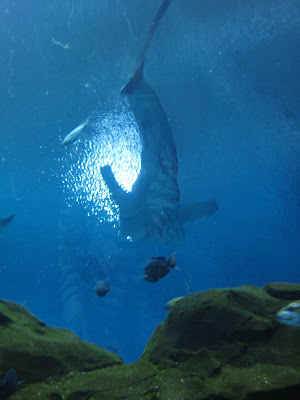
One of the extracurricular activities involved (free) dinner (and drinks) at the Georgia Aquarium. This was easily my favorite experience during my stay in Atlanta -- but even this was a letdown. Perhaps my pictures from the aquarium express my indifferent mood. That's how I interpret them.
The aquarium was dark -- darker than usual for aquariums. It was after hours for the place, and not all of the exhibits were open. Not all of the lights were on. Fair enough. As it turns out, the photos I took here perfectly captured my mood of Atlanta. Drab, dull, boring. Despite the cool aquatic life I was seeing. Steve Zissou would have had a ball here. Maybe the fish would have been more cartoonish, but I could see him staring at a fish that killed his friend -- and he would say, "Wow."
Actually, the aquarium was beautiful. It's hard not to just stare at all of the life, mouth ajar, music filling your ears with the appropriate ambient soundtrack. But the dark silhouettes against a monochromatic blue backdrop were enough for me to remember it wasn't that much different outside of the aquarium. And some of the fish were sharks...
On the last night of my stay there, the hotel room window was open and the random sounds of city life were heard endlessly. It was relatively cool that night, and a breeze blew into the room. That is a favorite memory of the place. Why? Because I didn't see the streets, the buildings, the cars, the people. I imagined some place better.


Unfortunately, with conferences, you do not have the power to control where you travel. So it is with Atlanta.
Atlanta, America's answer for the generic big, ugly, cold (in feeling, not in climate), boring city. I try to find the good things about a place, but Atlanta does not have very many of them. The airport? A disaster area. The downtown? Completely uninteresting. The traffic? Self-mutilation (or worse). The food? Greasy fast food does not make me a fan.
I've known a lot of people who have lived in Atlanta at one time in their lives. Many of them rave about it. The ramblin' wreck of Georgia Tech (read that as you like). Home of the Falcons. The Falcons! We have a dome. A nice dome.
Sorry, I'm not buying it. If you have nice property you'd like to "sell", at least tell me it's in an exotic location. Atlanta? No thanks.
My question is...who vacations to Atlanta? And better still...why? If you have family in Atlanta, why don't you meet them somewhere cooler? Savannah isn't that far away. Chattanooga is an easy drive on 75. Charlotte is just a half-day's drive on 85. There are mountains nearby. Nice ones!
The American Meteorological Society, in all of its wisdom, likes to have the Annual Meeting here. So it was in 2010. I generally don't look forward to this conference anyway. My grant sure doesn't like the bill, and I get so little out of it science-wise -- that I tend to look forward to the extracurricular activities far more than the actual reason for being there. Perhaps one day I'll write a rant on the AMS. I've had one coming for a while -- maybe the time is coming. I digress...
One of the extracurricular activities involved (free) dinner (and drinks) at the Georgia Aquarium. This was easily my favorite experience during my stay in Atlanta -- but even this was a letdown. Perhaps my pictures from the aquarium express my indifferent mood. That's how I interpret them.
The aquarium was dark -- darker than usual for aquariums. It was after hours for the place, and not all of the exhibits were open. Not all of the lights were on. Fair enough. As it turns out, the photos I took here perfectly captured my mood of Atlanta. Drab, dull, boring. Despite the cool aquatic life I was seeing. Steve Zissou would have had a ball here. Maybe the fish would have been more cartoonish, but I could see him staring at a fish that killed his friend -- and he would say, "Wow."
Actually, the aquarium was beautiful. It's hard not to just stare at all of the life, mouth ajar, music filling your ears with the appropriate ambient soundtrack. But the dark silhouettes against a monochromatic blue backdrop were enough for me to remember it wasn't that much different outside of the aquarium. And some of the fish were sharks...
On the last night of my stay there, the hotel room window was open and the random sounds of city life were heard endlessly. It was relatively cool that night, and a breeze blew into the room. That is a favorite memory of the place. Why? Because I didn't see the streets, the buildings, the cars, the people. I imagined some place better.


Tuesday, July 27, 2010
Stories from the Road -- Bonneville, OR
Oregon is such a beautiful state.
I first entered Oregon on I-84 from Idaho. I was in awe right from the start, with the dry, rolling terrain following the road for miles. I've always liked the look of hills without trees. For some reason, they seem more formidable to me. And the grass was brownish in color. It seems that when everyone thinks of Oregon, they think of rain forests -- the endless onslaught of rain coming in from the sea. Fog hanging on to the coastal hills, like a comforting blanket. It's easy to forget the open steppes and high-rising treeless mountains to the east.
Experiencing Oregon by driving through it is the way to do it. Seeing the land slowly become more lush, the trees thicker and thicker, the Columbia River wider and wider -- it's a gradual change, but an unmistakable one. Pay attention, and you notice the trees change, and with it, the wildlife. I was lucky enough to drive through here when the weather seemed to match the changes in habitat. As the rain forests began to appear near and west of The Dalles, a low stratus deck hung to the crests. A subtle mist could be felt as I stepped outside. Just miles to the east, the sun was shining and the temperatures were soaring.
The town of Bonneville is right along the Columbia River west of The Dalles. There is a scenic dam here, with a fishery and a bridge that caught my interest. Technically, the bridge is located in Cascade Locks -- but to me, the memory of the dam is forever intertwined with the Bridge of the Gods.
The reason this is the case (aside from their close proximity) is that everything seemed so lush and vibrant here. The grass was thick, the trees were infinite, and the hills added a sense of enormity to everything. By this point, the Columbia River begins to form the gorge, which becomes even more pronounced as it heads west to Portland.
Unquestionably, there is a sense that the world closes in on you as you head farther downstream, deeper into the gorge. A sort of natural claustrophobia is created, as the trees approach the river, the hills become higher, and the river widens. It's a beautiful squeeze play for drivers along the route.
The sound of the spillway at the Bonneville Dam is overwhelming, but away from the dam, there is nothing. No sound. The wind was nonexistent, and the mist silently rested upon anything everywhere. This was my first rain forest experience, which would only become more and more pronounced after our stop in Bonneville. Nevertheless, it was here that I realized that all of the stereotypes of rain forests were true. It was almost so green that even I could see it.
I spent a lovely couple of hours at the hatchery and the dam -- watching little kids point out the newest fish seen behind the glass. I always find it somewhat disconcerting that I cannot hear the sounds of water behind the glass. It adds a bit of mystery to it. It's like watching a film, in which the sound is suddenly taken out. Often, a director will choose slow motion during these scenes. In hatcheries and aquariums, it is always involuntary for me to do the same. Everything is slower, more amplified. A subtle shift in direction of the fish is immediately eye-catching.
And then, looking at the dam, the water turns into a blur. All of a sudden, the only sense I can remember is sound. The sound of water falling furiously into the river below -- the drops becoming one white rush -- indistinguishable from all of the others.
A curious combination -- both enhancing one sense at the expense of the rest. And in the rain forest of northwest Oregon, it makes perfect sense. With the world seemingly caving in on you, everything slows down. It's a good chance to observe what we commonly miss and frequently drive through -- at our ignorant misfortune.
I-84 in eastern Oregon
Columbia River just west of The Dalles
Bridge of the Gods
Cascade Locks
Cascade Locks and the Bridge of the Gods
Bonneville Dam
Near the fishery/hatchery
A stream just south of Columbia River in Bonneville
Bridge for the train in Bonneville
The hatchery in Bonneville
Wednesday, July 21, 2010
No Place Like Home -- Black Mesa, OK
I'm on the move starting tomorrow and will not be writing entries for the rest of the week.
---
Black Mesa is as far away from home in the state of Oklahoma as I can get. It has characteristics of the Oklahoma I have come to know, but its views hold promise for what lies just beyond the border. Black Mesa is a tease for the weary soul longing for changing terrain -- yearning for something different.
A theme of Oklahoma that I will probably harp on time after time is its vastness. Everything is big here...everything. With endless horizons and an overwhelming sky, Oklahoma is a place that reminds you very quickly how totally insignificant you are. Living here is not far from surviving. Plant life in the panhandle is sparse and tough -- painful to the touch and ugly to the lovers of forests. It is breathtaking in its harshness.
One thing I have always believed is that, most of the time, the more unlivable the conditions of a place, the more beautiful it is. The cacti of Arizona, the vast sand dunes of the Sahara, the permafrost of Alaska's North Slope, and the lonely snow of Antarctica -- all are seen as scary but beautiful places. Only the strong survive here, and we find the plants, animals, even people of these places, completely mesmerizing.
In many ways, Oklahoma is not that much different. The harsh climate, never-ending winds, insanely dry air from the deserts and the insanely moist air from the Gulf of Mexico -- combine to make Oklahoma a violently evolving terrestrial wasteland. In the panhandle, where there is more dry than moist, the plant life is unmistakably arid in origin. The animals are few and far between. Lizards and snakes crawl hurriedly across the landscape, and the brushy cactus whispers harshly in the gusts.
The sky is unrelenting. It pierces the skin quickly and furiously. Water looks strikingly beautiful here, because of its scarceness. I've never seen a sky match so beautifully with the landscape below than in the Oklahoma Panhandle.
A walk to Black Mesa in the summer of 2009 was one of my favorite memories of Oklahoma. It was hot. Very hot. The sun blasted through the high clouds and contrails as if they were not even there. The smell was of dirt and dung...cow dung, to be exact. And there were cows. Annoyingly, they were especially numerous at our destination: the highest point in Oklahoma. It has a statue and everything. Not that we'd know, since a few shall we say protective bulls were keeping it all to themselves.
It turns out, as in most things that our imaginations allow for, that the cows were a perfect metaphor for Black Mesa -- Oklahoma itself. At times, humans are not at the top. No, I wasn't worried the cows would eat us -- or even harm us. Then again, there's no reason to give them a reason to harm me. The cattle are big in Oklahoma too.
My friend Bryan and I saw the highest point in Oklahoma -- from a distance. We saw a few mesas -- another "big" thing in this state. We saw lonely windmills, mooing cows, slithering snakes, and flowers in cacti. Oklahoma isn't paradise, but then again, it doesn't have to be.
---
After about a week's hiatus, I'll return with stories from Bonneville, OR; Lake Tahoe; Atlanta, GA; and Silver Spring, MD.


---
Black Mesa is as far away from home in the state of Oklahoma as I can get. It has characteristics of the Oklahoma I have come to know, but its views hold promise for what lies just beyond the border. Black Mesa is a tease for the weary soul longing for changing terrain -- yearning for something different.
A theme of Oklahoma that I will probably harp on time after time is its vastness. Everything is big here...everything. With endless horizons and an overwhelming sky, Oklahoma is a place that reminds you very quickly how totally insignificant you are. Living here is not far from surviving. Plant life in the panhandle is sparse and tough -- painful to the touch and ugly to the lovers of forests. It is breathtaking in its harshness.
One thing I have always believed is that, most of the time, the more unlivable the conditions of a place, the more beautiful it is. The cacti of Arizona, the vast sand dunes of the Sahara, the permafrost of Alaska's North Slope, and the lonely snow of Antarctica -- all are seen as scary but beautiful places. Only the strong survive here, and we find the plants, animals, even people of these places, completely mesmerizing.
In many ways, Oklahoma is not that much different. The harsh climate, never-ending winds, insanely dry air from the deserts and the insanely moist air from the Gulf of Mexico -- combine to make Oklahoma a violently evolving terrestrial wasteland. In the panhandle, where there is more dry than moist, the plant life is unmistakably arid in origin. The animals are few and far between. Lizards and snakes crawl hurriedly across the landscape, and the brushy cactus whispers harshly in the gusts.
The sky is unrelenting. It pierces the skin quickly and furiously. Water looks strikingly beautiful here, because of its scarceness. I've never seen a sky match so beautifully with the landscape below than in the Oklahoma Panhandle.
A walk to Black Mesa in the summer of 2009 was one of my favorite memories of Oklahoma. It was hot. Very hot. The sun blasted through the high clouds and contrails as if they were not even there. The smell was of dirt and dung...cow dung, to be exact. And there were cows. Annoyingly, they were especially numerous at our destination: the highest point in Oklahoma. It has a statue and everything. Not that we'd know, since a few shall we say protective bulls were keeping it all to themselves.
It turns out, as in most things that our imaginations allow for, that the cows were a perfect metaphor for Black Mesa -- Oklahoma itself. At times, humans are not at the top. No, I wasn't worried the cows would eat us -- or even harm us. Then again, there's no reason to give them a reason to harm me. The cattle are big in Oklahoma too.
My friend Bryan and I saw the highest point in Oklahoma -- from a distance. We saw a few mesas -- another "big" thing in this state. We saw lonely windmills, mooing cows, slithering snakes, and flowers in cacti. Oklahoma isn't paradise, but then again, it doesn't have to be.
---
After about a week's hiatus, I'll return with stories from Bonneville, OR; Lake Tahoe; Atlanta, GA; and Silver Spring, MD.
Monday, July 19, 2010
Stories from the Road -- South Beach, FL
I've only been to Florida twice, and given my love for traveling, oceans, and thunderstorms, I find this completely embarrassing. What's worse, my two trips to Florida are most remembered for the beds I slept in. I will discuss the second trip's "bed to remember" presently.
I went with Somer to Miami in the fall of 2009, as she attended the University of Miami as an undergrad and OU was playing Miami that weekend. One view of the city at night is all you need to love this place, and it only gets better in the daytime. The palm trees are everywhere, the glorious white sand almost blinds the eyes, and the puffy cumulus clouds are a certainty by early afternoon. You can't help but catch yourself hearing the ocean, whether you're actually in sonic range or not. Even the traffic sounds like the ocean...
So, yes, I loved Miami, but I'm telling a story about a bed. Somer's college friend Chris was gracious enough to let us both stay in his apartment for the duration of our stay. It was a nice apartment -- very nice. Except for one thing, reminiscent of Martin Crane's ugly chair in the television show Frasier. The second bedroom, which basically was used as a study, had a bed that my back will remember for the rest of my days. I am convinced that this mattress is the reason there are all of these commercials promoting the absorbent impacts of a jumping child or a brick. That is, this mattress is the antithesis of the advertised no-impact bedding.
Because of the setup of the room (no carpet, little floor space), Somer and I were forced to sleep on this mattress-on-a-shingle. Any movement -- anything -- from tossing and turning to using the television remote control resulted in a shock wave on this thing. After several doses of Dramamine, the inevitable drowsiness was just enough to overcome the high surf on this non-waterbed. Several games of Sudoku were played, and the scribbling numbers made the game nearly impossible to complete after a few tiles were filled.
By the final night in town, I was a sleepless wreck. After enjoying a beautiful day in pristine South Beach, the repetitive sounds of ocean waves crashing to shore were too much for me to fight. This resulted in one of those rare instances where the position I fell asleep in was the position I remained in for the entire night. The crater that formed on the bed was a sight to behold -- my body's vengeful retaliation for the previous nights' insomnia. Never had I scorned the thought of a waterbed so much.
As much as I loathe that bed, the stay in south Florida was fantastic, despite the oppressive humidity. As I went outside for the final time in Miami, I could hear the imaginary ocean again. Roaring cars, the breeze in the palm trees -- replaced, by the smell and desire of the sea. It constantly calls you to the beach, and when you're away, it relentlessly beckons you to return. I would in an instant, even if I had to sleep on that damn thing again.
Saturday, July 17, 2010
No Place Like Home -- 'Neath the Western Sky
I'm starting a new series on the blog focusing on the place in which I am currently living. For now, that means Oklahoma, though the jury is still out on where it will be a year from now. After rummaging through a number of titles for the series of blog posts, I decided to embrace the cliche. There is, after all, no place like home -- no matter where you are and how long you live there.
It's what I tell myself about Oklahoma and what I tried to convince myself of for 18 years in northeast Nebraska.
Actually, it takes very little convincing. For example, the sky in Oklahoma is enough evidence that this is a place unlike any other. It is true that the sky is always telling you something, but in Oklahoma, it seems as if the sky is a canvas to an invisible painter. Whether the artist is a master of dada or impressionism, I don't know. It seems to depend on the day -- maybe the artist is temperamental.
Rarely a day goes by when I don't see a new picture of the Oklahoma sky. A meteorologist capturing the latest sunset, a traveler joining the deep blue sky with the endless landscape, a farmer taking a photo of a decaying barn underneath bubbling cumulus. As an extremely amateur photographer, a couple of years in Oklahoma has taught me to always make the sky a part of the image. Whether or not my imagination is at play here, the same land always looks different on a daily basis here. The soil absorbs the light a little differently, the lake twinkles the sunlight slightly differently.
To experience Oklahoma requires looking upward as well as outward. Living here gives you an appreciation of the word vast. Nothing is small here -- sweeping horizons, gusty winds, and reverberating echoes of history. It is a common theme of Westerns that all of the characters are ants in a large, unforgiving world. The climate is harsh, and the land makes no mistake about it.
Oklahoma is not a scenic wonderland, but there is beauty here. There is something to be said for the empty land and the unrelenting sky. It is not everyone's paradise -- certainly not mine -- but it is often worthy of photographing. Sometimes, it's even worth calling home.


---
Check out my sister's latest blog entry on bird watching in Belize!
It's what I tell myself about Oklahoma and what I tried to convince myself of for 18 years in northeast Nebraska.
Actually, it takes very little convincing. For example, the sky in Oklahoma is enough evidence that this is a place unlike any other. It is true that the sky is always telling you something, but in Oklahoma, it seems as if the sky is a canvas to an invisible painter. Whether the artist is a master of dada or impressionism, I don't know. It seems to depend on the day -- maybe the artist is temperamental.
Rarely a day goes by when I don't see a new picture of the Oklahoma sky. A meteorologist capturing the latest sunset, a traveler joining the deep blue sky with the endless landscape, a farmer taking a photo of a decaying barn underneath bubbling cumulus. As an extremely amateur photographer, a couple of years in Oklahoma has taught me to always make the sky a part of the image. Whether or not my imagination is at play here, the same land always looks different on a daily basis here. The soil absorbs the light a little differently, the lake twinkles the sunlight slightly differently.
To experience Oklahoma requires looking upward as well as outward. Living here gives you an appreciation of the word vast. Nothing is small here -- sweeping horizons, gusty winds, and reverberating echoes of history. It is a common theme of Westerns that all of the characters are ants in a large, unforgiving world. The climate is harsh, and the land makes no mistake about it.
Oklahoma is not a scenic wonderland, but there is beauty here. There is something to be said for the empty land and the unrelenting sky. It is not everyone's paradise -- certainly not mine -- but it is often worthy of photographing. Sometimes, it's even worth calling home.
Cedar Lake -- May 2009
The Wichitas -- February 2009
The Wichitas -- February 2009
Mt. Scott -- February 2009
Black Mesa -- June 2009
Black Mesa -- June 2009
Talimena Scenic Byway -- May 2009
Talimena Scenic Byway -- May 2009
Norman -- May 2009
Elk City -- April 2009
---
Check out my sister's latest blog entry on bird watching in Belize!
Subscribe to:
Posts (Atom)